Wednesday, April 23, 2014

The Jewelry Collection Of Elizabeth Taylor

Elizabeth Taylor: Famous Hollywood Actress, Glamorous Style Icon, Generous Humanitarian, and Lover of Fine Jewelry.

On 13 December 2011, Elizabeth Taylor's jewelry collection went on the auction block at Christie's for a record breaking $115.9 million USD, becoming the most valuable single jewelry sale in history at the time. The highlights of the sale include some riveting examples of diamonds and precious gems, the most notable of which are found below.


The Elizabeth Taylor Diamond

The Elizabeth Taylor Diamond is a 33.19 carat diamond, potentially flawless, of D color, set in a ring, as a gift from her fourth (and fifth) and possibly most notorious husband, Richard Burton. He purchased this diamond for her in 1968, originally known as the Krupp Diamond, from Sotheby's for $305,000 USD. Taylor reportedly wore it every day, even on movie sets, since acquiring it. The diamond was set by Harry Winston and came from the collection of Vera von Krupp von Bohlen und Halbach, which at the time of sale, was the highest price ever paid at auction for a diamond. Estimated at $2.5-3.5 million USD, the stone sold for $8,818,500 USD at an astonishing $265,697 USD per carat.

Elizabeth said of the stone:
This remarkable stone is called the Krupp diamond because it had been owned by Vera Krupp, of the famous munitions family that helped knock off millions of Jews. When it came up for auction in the late 1960s, I thought how perfect it would be if a nice Jewish girl like me were to own it. In truth, though, there's nothing funny about the Krupp. When I look into it, the deep Asscher cuts—which are so complete and ravishing—are like steps that lead into eternity and beyond. With its sparks of red and white and blue and purple, and on and on, really, it sort of hums with its own beatific life. To me, the Krupp says, 'I want to share my chemistry—my magic—with you.'

The Elizabeth Taylor/Krupp Diamond
picture via forbes.com

Taylor wearing her namesake ring


La Peregrina

La Peregrina, reportedly the largest symmetrical pear-shaped pearl in the world, has enjoyed a 500 year history of prized adornment in the hands of Europe's royalty. Found on the coast of Panama in the mid-16th Century, the pearl was given to Phillip II of Spain who presented it to his future bride, Mary I of England. The pearl stayed in the Spanish crown jewels for the next 250 years, remembered in the portraits of many subsequent Spanish Queens.

In the early 19th Century, the pearl came into the hands of the Bonaparte family when Napoleon I made his elder brother, Joseph, the King of Spain, and it traveled with him to England upon his exile along with other pieces of the Spanish crown jewels. It is at this point in history that the famous pearl acquired its name, "La Peregrina," meaning "The Wanderer." It was then sold to James Hamilton, the 1st Duke of Abercorn, and stayed within his family until 1969 when it went up for auction at Sotheby's.
A portrait of Mary I of England showing her wearing La Peregrina as a pendant beneath a large stone, by Hans Eworth, 1554
 
A portrait of Margaret of Austria, Queen of Spain, wearing La Peregrina as a pendant, by Juan Pantoja de la Cruz, 1606

Portrait of Elisabeth of Bourbon, Queen of Spain, wearing La Peregrina, by Peter Paul Ruebens, Circa 1625


At the Sotheby's auction in 1969 Richard Burton purchased the pearl for $37,000 USD for his wife, Elizabeth Taylor, as a Valentine's Day present. Taylor would then have the famous jeweler, Cartier, redesign the necklace resulting in an intricate setting of rubies, pearls, and diamonds. In 2011 when the pearl went to auction again as the new Cartier designed necklace, it would reach an astonishing $11,842,500 USD, setting a record for highest price reached for a single pearl jewel.

It has been said that Mr. Burton was a history buff and therefore gravitated to pieces of historical significance. The Taylor-Burtons purchased a painting of Queen Mary I wearing the pearl, but upon hearing that the British National Portrait Gallery did not have an original painting of Mary, they donated the portrait to the museum.


 Elizabeth Taylor wearing La Peregrina in a necklace fashioned by Cartier


The Taj Mahal Diamond

The story of this stone begins in the early 17th Century India when Shah Jahangir acquired the diamond and had it inscribed in Persian with the name of his wife, Nur Jahan, along with numbers indicating a date equivalent to 1627-28 AD, corresponding to his reign. It then passed to his son, Shah Jahan, who gave it as a token of his love to his favorite wife and closest trusted advisor, Mumtaz-I-Mahal. She would bear him fourteen children before dying in childbirth in 1631, after which Shah Jahan locked himself in his room and refused to eat for eight days out of sickened grief. He would later construct the Taj Mahal mausoleum in her memory which took over 20,000 workers and 20 years to complete. It stands today in Agra as one of the most elegant examples of architecture ever constructed.

Richard Burton purchased the diamond  in 1972 for Taylor and presented it to her on the occasion of her 40th birthday. He reportedly claimed he wanted to buy her the Taj Mahal monument, "but it would cost too much to transport," and opted for the diamond instead.

With an original auction estimate of $300,000 - 500,000 USD in 2011, the diamond sold for an incredible $8.8 Million USD. The diamond's setting was replaced by yellow gold cord set with rubies, in a design by Cartier mimicking the original setting having been hung by a silk cord.

The diamond is most likely carved from a macle, which results when a diamond effectually turns on itself and grows in the opposite direction, creating a "twinned" flat triangular shape. Common cuts of these diamonds today are referred to as "Triangular Brilliant" or the "Trilliant" cut. The Taj Mahal Diamond is unique in that it is a very large example of a macle and was not carved with a multitude of facets, but instead has been engraved.


The Taj Mahal Diamond 

Elizabeth Taylor wearing the Taj Mahal Diamond

Monday, August 5, 2013

It's been a while since I last posted!

Have a look at this article from Rohin Dahr, Co-founder and CEO, Pricenomics

http://blog.priceonomics.com/post/45768546804/diamonds-are-bullshit

Thursday, January 31, 2013

The Wittelsbach-Graff Diamond and the Meaning of Ownership

On 10 December 2008 in the Jewels sale at Christie's, King Street in London, an historically significant blue diamond sold for a record breaking (at the time) price of GBP 16.4 million (USD 24.3 million). The cushion-shaped Fancy Deep Grayish Blue diamond, then known as the Wittelsbach Diamnond, carried a deep and rich 300 year history in the Spanish and Bavarian Royal families, belonging to Princesses, Kings, and Holy Roman Emperors. Weighing 35.56 carats and graded by GIA as having a VS2 (Very Slightly Included) clarity, it was purchased by a well known name in the jewelry industry, Mr. Lawrence Graff. Soon after the sale, Mr. Graff announced his decision to re-polish (cutting and resurfacing) the diamond which resulted in a 4.45 carat reduction (now at 31.06 carats) but with an upgrade to the color and clarity at the more desirable grade of IF (Internally Flawless) and Fancy Deep Blue. This major change also meant an alteration to the diamond's name, now known as the "Wittelsbach-Graff Diamond."
A Rich History

Suspected to be unearthed from the mines in the ancient Kingdom of Golconda in Hyderabad State in India, the diamond shares its origins with such famous stones as the Hope Diamond (45.53 cts., Fancy Dark Grayish Blue, VS1), the Koh-i-Noor Diamond (186 cts, White), the Darya-ye Noor Diamond (182 cts., Pale Pink), and the Regent Diamond (140.64 cts., White/Pale Blue). All of these stones are reported to have been found around 17th Century, during the time when India was the worldwide diamond source.


The Wittelsbach-Graff diamond traces its lore to King Phillip IV of Spain. When his teenage daughter, the Infanta Margarita Teresa, was betrothed to Leopold I of Austria, he assembled a collection of fine gems for her dowry which included the mesmerizing blue stone. After her untimely death in 1673 at the tender age of 21, her husband kept the dowry, ultimately passing the diamond to his third wife, who then bequeathed it to her granddaughter, Archduchess Maria Amalia in 1720. When the Archduchess married the Bavarian Crown Prince, Charles Albert, the blue diamond gained the house name of Wittelsbach as well as the moniker "Der Blaue Wittlesbacher." Subsequently passed down through further generations, the stone would ultimately come into the hands of Maximillian IV Joseph von Wittelsbach, the first King of Bavaria. He commissioned a crown in 1806 to include the blue diamond and family heirloom, where it remained until 1918 after the proclamation of the Republic.

In 1931 Christie's auction house offered a sale of important jewelry from the Bavarian Crown Jewels which included the Wittelsbach Diamond. After the sale the diamond's whereabouts have become somewhat of a mystery, entering into the hands of an unknown family and not returning to the public sphere until the recent sale in 2008. There was a brief moment in the 1960s where the diamond was brought to a well known jeweler to be recut under the pretense that it was merely an old mine cut stone. After recognizing the significance of the diamond and its history, the jeweler refused to alter such an important piece and instead joined together with several other jewelers to purchase the stone where it remained until 2008.


The Controversy

Since the original cutting of the Wittelsbach, technology and methodology of diamond cutting has certainly improved. In addition, and contrary to popular belief, a diamond is not indestructible; under certain conditions a diamond can indeed chip and gain undesirable blemishes. Mr. Graff, a leader in the gem profession, claims that the decision to re-surface the diamond was to remove the damage caused over the years, and to increase the clarity, color, and of course the monetary value of the stone. While he did achieve this goal, many Art Historians, collectors and members of the Jewelry industry alike were outraged at the alteration of such a historic piece.


Daniela Mascetti, a Senior Specialist in Jewelry at Sotheby's said, "the provenance of a gem is important in ways that are not true of other things. With the Wittelsbach blue, you knew how it came into existence and in a rather exciting way. You know who has worn it, what kinds of historical events it has gone through and what social upheavals it was present for. In a way, it is a shame to have altered what has been preserved for som many years. Do you still have the original stone found by Tavernier or cut in his time? Will that stone still be the Wittelsbach? In my opinion, it is not."

Hans Ottomeyer, Director of Berlin's German Historical Museum remarked that the cutting was akin to "buying a Rembrandt and repainting it." By cutting the diamond, the loss of the marks acquired during its history have also removed the diamond's connection to it's history. It is not the same diamond. 

Mr. Graff's response to such claims was, "If you discovered a Leonardo da Vinci with a tear in it and covered in mud, you would want to repair it. We have similarly cleaned up the diamond and repaired damage caused over the years." Mr. Graff believes in the restoration of the stone. The market value certainly has increased based on color, cut, and clarity, at a loss to the carat weight. He possibly believes the value is in the stone itself, not necessarily the historical significance. 

So the question is this: If you purchase an historically significant piece of artwork or an artifact, what is your duty to that piece? To society? After the purchase, does it belong to you fully, without any requirement of preservation of that piece, or are you it's custodian; the guardian of its legacy? 

What are we bound to protect as a society? What belongs to us after a purchase? Should these pieces be allowed to be purchased by private hands? 

The conversation will undoubtedly continue. 


Tuesday, January 8, 2013

Kitsune and the Celestial Fox

'Kitsune is an animal supposed to be mysterious, fascinating, and mischevious. And he is believed to be very grateful for the kindness done to him, as seen in many tales, and is also affectionate as revealed in some dramas. He is enshrined as a god because of his supernatural power. He is endowed with the subtle art of metamorphosis, and he is able to bewitch men in the guise of a charming girl. An exceedingly interesting and entertaining beast Kitsune is.' -Kiyoshi Nozaki 


The fox and the human share an interesting relationship in Asian folklore. "Kitsune" is the general term for fox in Japanese, and in mythology it implies the essence of a spirit being, whether it be good or evil. Generally perceived to be a female creature, the fox spirit is a moralizer, a humiliator, and a seductress. She is also known to possess humans and this has historically been an explanation for mental illness in eastern lands. The fox is wise and often takes it upon herself to teach humans moral lessons, especially for the greedy or those full of hubris. 

There are many classifications of fox spirits in folklore based on their moral inclinations, coloring, age, and powers. Known even in western societies as a trickster, the fox is portrayed in eastern tales as somewhat magical spirit who can take the form of a beautiful woman after 100 years of age. Over time, the fox develops more powers and with that, more tails. By the 1,000th year, the fox has the ability to grow nine tails and becomes a supreme celestial being. In this case, she is either seen as a benevolent and wise figure or as a terrorizing beast. 

In the mythological wood block print by Utagawa Kuniyoshi (Edo period, early 19th Century), Prince Hanzoku (of Southern India) is portrayed as being attacked by a nine tailed fox. In this particular representation the celestial fox carries a malicious countenance with his fangs bared and his nails drawn.


Interestingly, the fox has been adopted as part of the official religion in Japan, Shinto. Kitsune are said to be servants to the rice-god Inari and one will find images of white foxes in an Inari shrine. These white foxes are called "Myobu," which is also a court ranking for certain ladies in Japan. The story goes that one night a kitsune family sought shelter in an Inari temple. In exchange for sanctuary, they pledged their servitude forevermore. The male fox, called "Genko" and usually depicted in art as black in color, serves the upper floor of the temple, while the female, called "Byako" and white in color, serves the lower floor. The Myobu at the Inari temples are not the regular trickster foxes of common tales, but instead good omens and benevolent beings; the Celestial Fox. 

Below is an ivory netsuke, sold at Bonhams 8 November 2011 in London. This carving depicts the oft represented fox-priest Hakuzozo. At about 4 inches high, the kitsune is anthropomorphically depicted as a fox-faced human dressed in priest's robes and holding a cane with human hands and human feet. 


The story is common in Chinese folklore as well. In fact, it is suggested that the Japanese borrowed some of their current tales from Chinese stories. For example, until 11th Century, foxes had only been known to be benevolent creatures, whereas in China they had been long been known to be capable of evil or doing tricks. It is also suggested that these stories further came originally from Indian lands before arriving in China, then making its way across the water to infiltrate the tales in Japanese culture. 

In China, the fox spirit is known as "Huli Jing," and much like the Japanese counterpart, are known tricksters, seductresses, and humiliators, among other many virtues. Huli Jing was known as a sometimes companion to humans, even a drinking companion. In modern colloquial terms, Huli Jing can refer to a woman of promiscuity, a dangerous seductress, a slut or whore. 

"Jiuwei Hu," the Chinese celestial fox, is thought to originally be a totem of ancient tribes. In the Eastern Han Dynasty (25-220), the likeness was depicted as a monstrous fox with fiery hair and nine tails, whereas in the Ming and Qing Dynasties (1368-1911), Jiuwei Hu was depicted as a beautiful woman, sometimes with a fox shadow.


pictures via


Some who played the Japanese manufactured Sega video game "Sonic the Hedgehog" from the 1990s will remember his golden colored fox companion with two tails, aptly named "Tails." While the Sega team does not directly inform that he was meant to be a mythological kitsune, it is quite arguable that he embodies certain traits. As there are some who believe his additional tail comes from maturity in the Japanese folklore tradition, there are others who prefer to believe his dual tails are some sort of genetic mutation. This is simply an example of the magestic fox spirit lore that continues to permeate society, even in popular culture. 


Thursday, January 3, 2013

Notes on Netsuke

A fascinating and very unique art form to Japan is the functional netsuke ("neh-tsu-keh" or sometimes improperly "net-ski") which means "to attach the root." Prior to the 17th Century, the netsuke was a very simple and utilitarian toggle, such as a stone or piece of wood. It did not gain popularity as an art form until the Edo period (17th-19th Century), where it flourished into intricate carvings of animals and figures representing daily life and myths alike.

Until the late 19th Century and early 20th Century, the Japanese wore traditional garments known as kimonos or kosode. Unfortunately for those who wished to carry their personal effects with them, these long robes did not come with pockets. In order to meet this need, the solution was to carry items by way of containers hung from the belt by a silk cord.

The entire suite of cords, netsuke, and container is called a sagemono. An inro is a box, usually intricately carved and decorated, made of several compartments to hold currency, tobacco, and medicines among others. The compartments of the inro are held together by an ojime, a bead like fastener, which slides down the cord to either access or secure the box. The cord is then placed behind the obi, or sash/belt, where it is attached to the button like netsuke hanging over the top of the obi for security.


Intricately carved of ivory or wood, the netsuke usually ranges from about 1 to 2 inches in size. You can distinguish a netsuke from other miniature carvings by the two small connecting holes drilled into it to loop the cord.


There are several styles of netsuke, but the most collectable type is the katabori, which is carved fully in three dimensions. These are prized for their skilled craftsmanship and artistry that developed during the Edo period. Interestingly, while it was the western fashion influence which brought an end to the functional need of the sagemono, and therefore the netsuke, it was also the western interest and recognizing artistry and beauty in the netsukes which made them a collectable item.

After the 1920s, artisans began making netsukes for tourism and commercial purposes. As it is difficult to date ivory, one can make assumptions based on color, patina, imagery, craftsmanship, and functionality. Sometimes the newer items are easier to spot because the carving and artistry is of a lesser quality. As they were not intended for practical use, one can also look for protrusions or breaks that may have been a flaw in the design for functional wear.

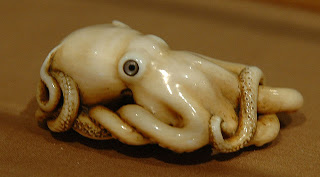
Imagery typically ranged from figural, animal, erotic, and mythical. Some examples are below.